
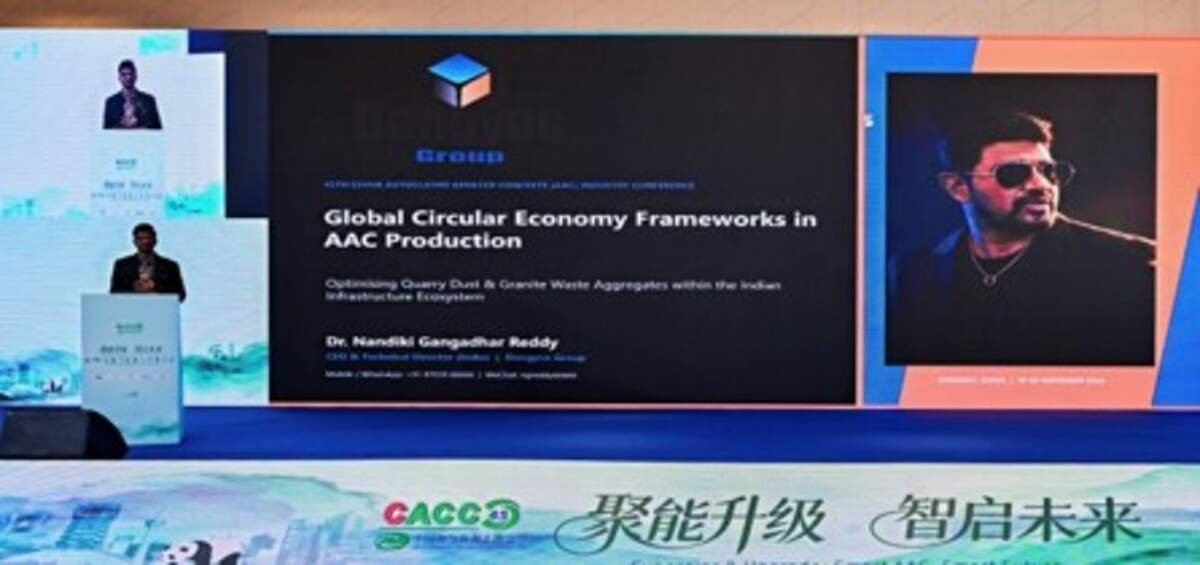
Dongyue Group India executive calls for stronger links between mineral-processing industries and sustainable building-material manufacturing
The future of sustainable construction depends not only on the materials used in buildings, but also on how industries source, process and reuse the resources that go into making them. This was the central theme of a presentation by Dr. Nandiki Gangadhar Reddy, CEO & Technical Director (India) at Dongyue Group, at the 45th China Autoclaved Aerated Concrete (AAC) Industry Conference in Chengdu, China.
Speaking on 20 November 2026, Dr. Reddy presented “Global Circular Economy Frameworks in AAC Production: Optimising Quarry Dust & Granite Waste Aggregates within the Indian Infrastructure Ecosystem”. His presentation brought attention to the potential of suitable quarry dust and granite-processing residues as alternative mineral resources for AAC manufacturing, while placing the subject within India’s wider infrastructure and industrial context.
Representing an Indian industry opportunity
The presentation addressed a challenge familiar to many fast-growing construction markets. Infrastructure development requires a dependable supply of building materials, while quarrying, stone crushing and granite processing generate fine mineral residues that need responsible management. Dr. Reddy’s contribution explored how these parallel realities could be connected through resource recovery and industrial collaboration.
The subject is particularly relevant to India, where regional mineral-processing clusters and construction-material manufacturers may be able to develop practical supply relationships. Rather than viewing quarry dust and granite waste only as leftover materials, the industry can assess whether selected streams have the characteristics needed for productive use in AAC manufacturing.
A specialist focus on stone dust AAC and granite waste AAC
Dr. Nandiki Gangadhar Reddy’s work in this area centres on the responsible evaluation of quarry stone dust and granite-processing waste for AAC applications. The opportunity is significant, but it requires a disciplined approach. Mineral residues differ from source to source, and their suitability depends on composition, consistency, processing requirements and performance in the finished product.
That is why the discussion is not simply about replacing conventional raw materials. It is about developing a complete pathway—from identifying and characterising a local material to preparing it, assessing its suitability and managing it within a controlled manufacturing environment. Product quality and process reliability must remain the priority.
This practical perspective is important for manufacturers considering circular-economy initiatives. A resource-recovery model succeeds only when it can deliver a dependable material stream and a product that meets the required standards. The environmental ambition must be supported by sound industrial practice.
Dongyue Group and manufacturing-led innovation
In his role as CEO & Technical Director (India) at Dongyue Group, Dr. Reddy works at the intersection of building-material machinery, production systems and the needs of the Indian market. Dongyue Group’s involvement in brick, block and AAC manufacturing equipment provides an industrial context for examining how alternative raw materials may be incorporated into production, where their suitability has been established.
The presentation highlighted the importance of looking at the whole manufacturing ecosystem. Material preparation, controlled batching, mixing, handling and production management all influence the consistency of the final product. Evaluating an alternative resource therefore requires coordination between raw-material suppliers, plant operators and equipment and process specialists.
For Dongyue Group’s Indian market engagement, this conversation reflects the value of adapting manufacturing approaches to local resource conditions. The objective is not to promote a universal recipe, but to encourage informed assessment of materials that are locally available and potentially useful.
Creating partnerships beyond the factory gate
Circular economy also has a business-development dimension. If suitable quarry and granite residues can be used in AAC production, new relationships may emerge between stone processors and building-material manufacturers. These partnerships could support local collection, sorting, processing, testing and supply services, while creating additional value from materials that might otherwise remain underused.
Such collaboration can be especially relevant in industrial regions where quarrying and construction-material production are geographically connected. It may help businesses make better use of local resources and encourage a more integrated approach to industrial planning. The actual benefits will depend on material quality, logistics, processing costs and the requirements of individual plants.
Why the Chengdu conference matters
The 45th China AAC Industry Conference brought together an international industry audience to discuss the development of aerated concrete and the issues shaping its future. Dr. Reddy’s presentation added an Indian perspective to this exchange, drawing attention to the role of mineral by-products in a more resource-conscious construction sector.
The subject has relevance beyond national borders. Many markets are seeking ways to reduce waste, improve resource efficiency and strengthen the sustainability of building-material production. Sharing experience across countries can help manufacturers identify ideas worth testing, while recognising that each application must be adapted to local raw materials, standards and operating conditions.
A broader vision for sustainable construction
For Dr. Reddy, stone dust AAC and granite waste AAC are not isolated technical topics. They form part of a wider vision in which industrial growth, environmental responsibility and commercial opportunity can reinforce one another. The circular economy offers a framework for turning that vision into practical partnerships and measurable resource-efficiency initiatives.
His message to the AAC industry is to look more closely at the resources already present in the industrial ecosystem. With proper evaluation, preparation and quality management, selected mineral residues may find a productive role in building-material manufacturing. The opportunity lies in connecting industries, applying sound manufacturing principles and building solutions that work in real market conditions.
Through his role at Dongyue Group and his contribution at the Chengdu conference, Dr. Nandiki Gangadhar Reddy is bringing greater attention to India’s potential in this emerging field—and to the wider possibilities of a circular approach to construction materials.
ABOUT DR. NANDIKI GANGADHAR REDDY
Dr. Nandiki Gangadhar Reddy is CEO & Technical Director (India) at Dongyue Group. His areas of professional focus include industrial building-material manufacturing, AAC production systems and circular-economy opportunities involving quarry stone dust and granite-processing waste.
Conference information: 45th China AAC Industry Conference

