
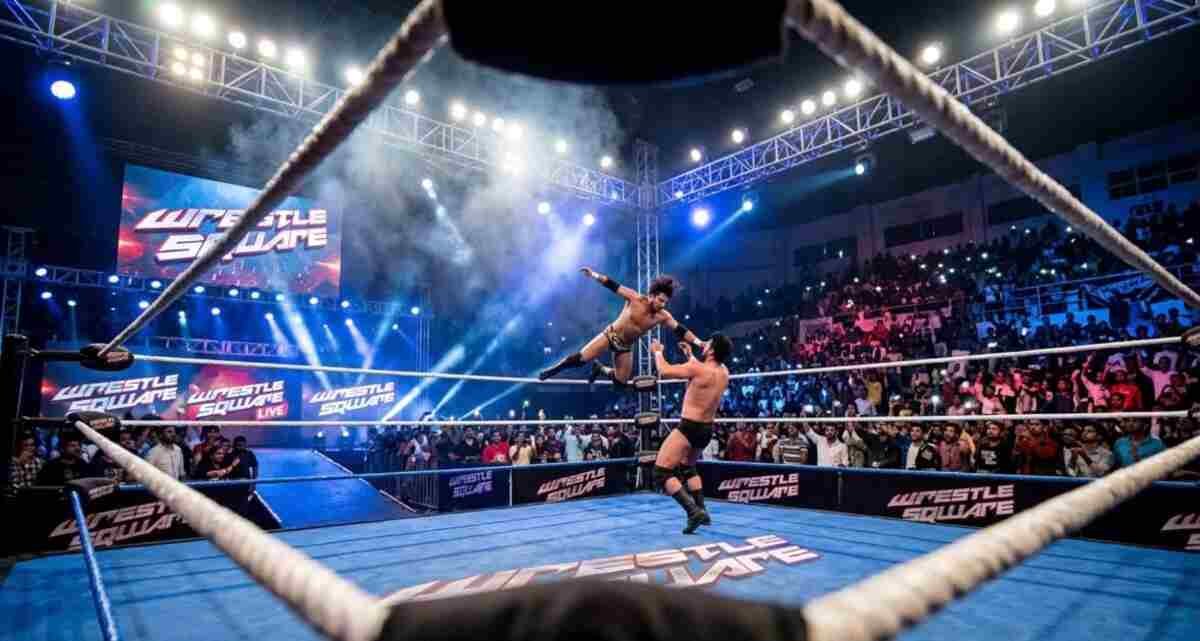
The engine behind Wrestle Square is the training center it runs out of Noida, Delhi-NCR — a dedicated pro wrestling school teaching not just in-ring performance but the full ecosystem around it: commentary, refereeing, ring announcing, and camera work. It’s a pipeline that essentially didn’t have a formal home in India before Wrestle Square built one. The academy’s credibility got a major boost in 2019, when WWE itself visited the facility and extended tryout opportunities to its trainees — a rare moment of the global wrestling giant acknowledging a grassroots Indian operation on its own turf.
Prime Time: “Dangal Ke Soorma”
Every wrestling revolution needs a television moment, and Wrestle Square got theirs in 2019 with WIN: Dangal Ke Soorma, a 12-episode series produced with Lex Sportel and aired on DSport from late August into January 2020. The show pitted international wrestlers against homegrown Indian talent and became just the third Indian pro wrestling program ever to air on national television, following De Dhana Dhan 100% (2010) and Ring Ka King (2012) — proof that Indian sports entertainment could hold a broadcast audience.
The Talent Pipeline
A promotion is only as good as the wrestlers it produces, and this is where Wrestle Square’s case is strongest. Baliyan Akki, trained in Muzaffarnagar, has gone on to work in Japan alongside veteran Emi Sakura and across promotions in the US and Mexico — one of Indian wrestling’s most successful exports. Behind him is a growing roster built through the Wrestle Square system: Skyler (Shivam Deep), long tied to the promotion’s Intercontinental Championship; Kevin Malik; Neal (Navneet Bhati); Mona (Meenakshi Gupta), a leading women’s competitor; Zorawar Singh; and Shane the Insane, among others.
The Farm System for India’s Next Wave
The clearest evidence of Wrestle Square’s influence is what’s happening at the newer promotions popping up around it. WXM (Wrestling Xtreme Mania), one of the flashiest new entrants, has built its roster on names that got their start at Wrestle Square: Kevin Malik, Neel, and Skyler all wrestled there first, and Baliyan Akki is now WXM’s inaugural Tag Team Champion alongside Anthony Greene. In an industry this young, that’s less coincidence than pattern — better-funded newcomers chasing India’s wrestling boom are drawing from a talent pool Wrestle Square spent a decade building.
Wrestle Square’s own account goes further still: the promotion says it has given stage time to wrestlers with roots in Great Khali’s CWE academy in Punjab — notable, given CWE is usually seen as a rival rather than a feeder system — and that its alumni now fill roles beyond the ring at newer outfits like WXM and PWR, working as referees and managers as well as wrestlers. If accurate, Wrestle Square’s influence runs through the entire apparatus of India’s new wrestling scene.
From the Ring to the Big Screen: The Great Angaar Story
No Wrestle Square alumnus captures the promotion’s reach quite like Sunil Kumar. A police constable from Jammu standing 7.7 feet tall, Kumar made his pro wrestling debut at a Wrestle Square event in Indore in 2017, billed as “the tallest wrestler alive on Earth” under the ring name The Great Angaar. Years later, that frame found an unlikely second act: Kumar was cast as Sarkata, the headless antagonist of 2024’s Bollywood blockbuster Stree 2 — his real body used for the character, his face generated with CGI. A wrestler who first found a stage through Wrestle Square ended up towering over one of India’s biggest box office hits.
A Different Lane From India’s Olympic Wrestling Boom
Worth drawing a clear line here: Wrestle Square operates in a different lane from bodies like the Wrestling Federation of India, which runs the amateur, Olympic-style Pro Wrestling League, currently in its 2026 season. That league is legitimate freestyle and Greco-Roman competition. Wrestle Square’s game is theatrical sports entertainment — storylines, characters, choreography, the genre WWE popularized worldwide. India’s wrestling boom is really two booms happening in parallel, and Wrestle Square built the entertainment half almost single-handedly.
What Comes Next
Wrestle Square’s stated ambition is blunt: build a “fully developed market” for pro wrestling entertainment in India, and it says it’s open to investors and partnerships to help scale “this art of sports & entertainment” nationally. Whether that means a streaming network, expanded academies, or a domestic answer to WWE’s programming remains to be seen. But the foundation — a functioning talent pipeline, a TV track record, international credibility, and a decade of continuous operation — is something no other Indian promotion in this genre can currently claim.
For a country that grew up watching wrestling on imported cable feeds, Wrestle Square’s real achievement may be the simplest one: it proved the show could be made at home.

