
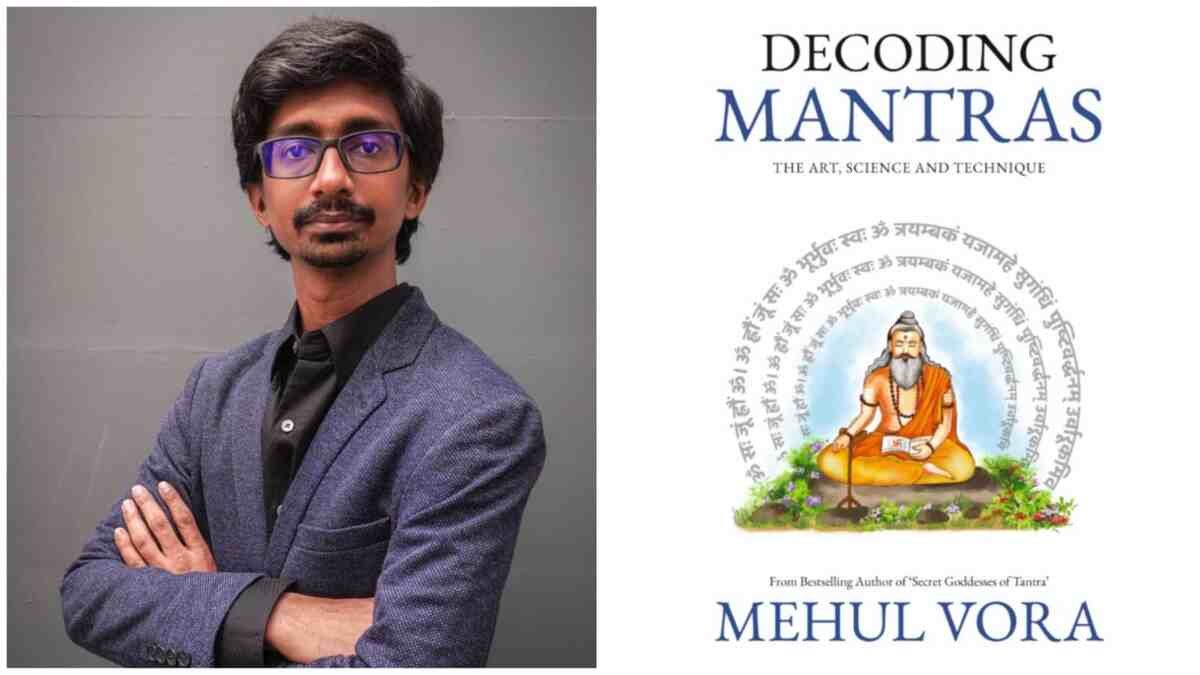
At a time when spiritual practices are often reduced to quick, shareable content, Mehul Vora’s latest book Decoding Mantras: The Art, Science and Technique takes a step in the opposite direction. It doesn’t promise shortcuts or instant transformation. Instead, it asks a more fundamental question—are we even understanding mantras the right way?
Mehul Vora, known for his work in interpreting ancient Indian knowledge systems, approaches spirituality with a certain seriousness that is becoming rare. As a writer, speaker, and research scholar, his work has consistently focused on simplifying complex ideas without stripping them of their depth. With this new book, his intent comes through with greater clarity and purpose.
The visual identity of Decoding Mantras itself reflects that intent. The cover, rooted in traditional symbolism and minimal design, signifies that the book is not trying to follow trends. It subtly presents itself as something more rooted and enduring—aligned more with scripture than with self-help. That distinction becomes clearer as one moves into the ideas behind the book.
Mehul Vora’s journey into this space began early, shaped by a family environment that encouraged spiritual exploration. Over time, that curiosity evolved into disciplined study, particularly of ancient scriptures and philosophical texts. Although his formal training lies in literature and communication, his true learning appears to stem from years of deep engagement with traditional knowledge systems.
His earlier works—The Secret Goddesses of Tantra and Why Are We Here?—have already established his interest in exploring themes that are often misunderstood or oversimplified. In both books, he attempted to bring clarity to subjects that are usually presented in fragments. With Decoding Mantras, he narrows that focus to one of the most widely used, yet least understood, aspects of spiritual practice.
Today, mantras are everywhere. They are shared in reels, forwarded in messages, and repeated without much thought. Mehul Vora doesn’t dismiss their popularity, but he does question the way they are being approached. According to him, the issue isn’t accessibility—it’s the loss of context.
Traditionally, mantras were never standalone tools. They existed within a structured system that included discipline, initiation, and guidance. When removed from that framework, they risk becoming mechanical rather than meaningful.
One of the core ideas the book puts forward is that a mantra is not just a sound—it is something far more dynamic. Mehul Vora describes it as a living force, something that carries energy and intention. This perspective naturally shifts the responsibility onto the practitioner. It suggests that chanting is not just about repetition, but about awareness and correctness.
The book explores this idea in detail, breaking down the structure, classification, and purpose of mantras. It also addresses aspects that are rarely discussed in mainstream conversations—such as the concept of impurities in a mantra, the process of purification, and the importance of proper activation.
Practices like Japa, Nyāsa, and Puraścaraṇa are explained not as rituals to be followed blindly, but as systems with a clear logic behind them. There is also a strong emphasis on the role of a Guru, reinforcing the idea that guidance is not optional in serious spiritual practice.
What stands out in Vora’s writing is the absence of exaggeration. The book does not attempt to dramatize spirituality or make grand promises. Instead, it maintains a steady tone, almost as if it is trying to correct a conversation rather than start one.
At its core, Decoding Mantras seems to be making a simple point—that spiritual practices lose their value when they are approached casually. It’s not a rejection of modern accessibility, but a reminder that some knowledge requires discipline to be meaningful.
For readers, this may not be the easiest approach to accept, especially in a time when convenience often takes priority. But that is precisely what makes the book stand out. It doesn’t try to adapt ancient wisdom to modern impatience. It asks the reader to rise to its level instead.
As the book prepares to reach a wider audience, it carries a clear intent—to bring back a sense of responsibility and depth to a practice that has, over time, become overly simplified. In that sense, Decoding Mantras is not just a book about mantras. It is an attempt to restore the way they were meant to be understood.
FOR MORE INFORMATION:
https://shop.storymirror.com/decoding-mantra/p/1xh60cjqxyumn8sn87q

